Search This Blog

Friday, 27 March 2015

Water Line

In January this year I was invited to go for a walk. This was not just an ordinary walk - it was a section of a much bigger walk initiated by Clare Whistler and Charlotte Still as part of their residency at Herstmonceux Castle called underwater edge.

On the walk were several other fascinating creative people and we had all been invited to accompany Clare and Charlotte as they walked the ancient tide line of the sea across the Pevensey Levels. 

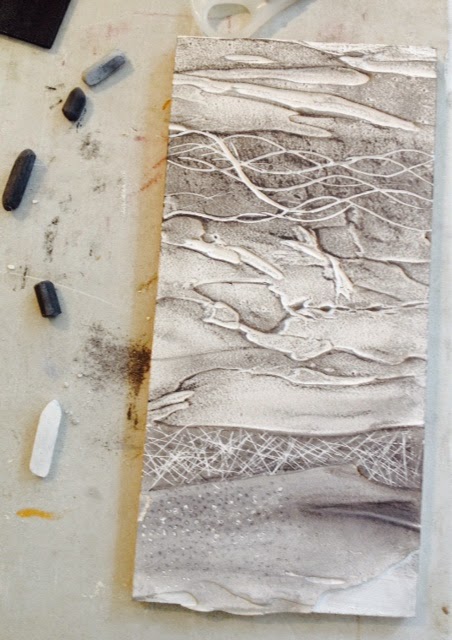
For me it was the first day back of school term, the first time I had the opportunity to work after the Christmas holidays and the first time I had met all these interesting people. It triggered a whole body of work, extending ideas and parallels with the work I had been doing previously. I had been looking at landscape searching for line and curve within it and eroding layers to create complex surfaces using Charcoal and gesso on board. 

The walk threw up so many ideas it was almost too difficult to keep track of them and after trying a few out I realised the effect of the walk was going to be more fundamental than just a new idea for a piece of work. 

So I left them all in the sketch book and just carried on working... this allowed the work to evolve informed by this very tangible experience ...and this was just from one walk! 

Clare and Charlotte created Water Week 2 in order to embrace all the input and connections they had made during the residency and also to provide a space for any artists to contribute work which had been inspired or made influenced by the walks. (they did several with other artists). 

I was delighted to be able to contribute 4 boards and to offer Water line, an action drawing, on the Saturday afternoon at the Castle. 

It was amazing to see my work placed in the location of the Castle imbued with time, history and purpose. It made me even more aware of how important location and context is to art work. 

Water line is a departure from In line, a drawing made by skating through pigment, charcoal and ash. 

In line (detail)

Water line uses the location and nothing more, the sun dries the water and drawings can be made repeatedly. My 3 children joined in with Water line and it kept them occupied for 2 hours, skating and scooting delighted with the marks and lines they were creating and building up together. 


 drawing moat water 


seam 2 - pigment, gesso and charcoal on board 

seam 1 - pigment, gesso and charcoal on board 


deposit - pigment, gesso and charcoal on board 

boundary- pigment, gesso and charcoal on board 


Boundary in the Castle 


Deposit in Gallery North, Hailsham 


5 senses workshop Touch

Touch was both the first and the last of the 5 senses workshops with the Naked Eye drawing group and produced some really lovely work. (I ran a Touch workshop last year as a space filler for Jo Kori with her Naked Eye drawing group who meet every fortnight at the The Beacon, Hastings. 

We handled various objects brought in and described them to each other to practice articulating the feel and sensation of what we were holding without looking at the objects. 

This was later translated into marks, so for example surfaces described as furrows, edges, thin lines, rough patches, heaviness, holes and indentations were then created by mark with materials including plaster on board and charcoal. Another exercise was pure contour drawing and drawing from touching the profile of the face without looking.

I've been really grateful for the opportunity to run these workshops in experimental mark making using the 5 senses as a point of departure. It's  been a learning curve for me to test them out. My thanks go to the very committed Naked Eye drawing group for asking me in the first place and throwing themselves into them! 

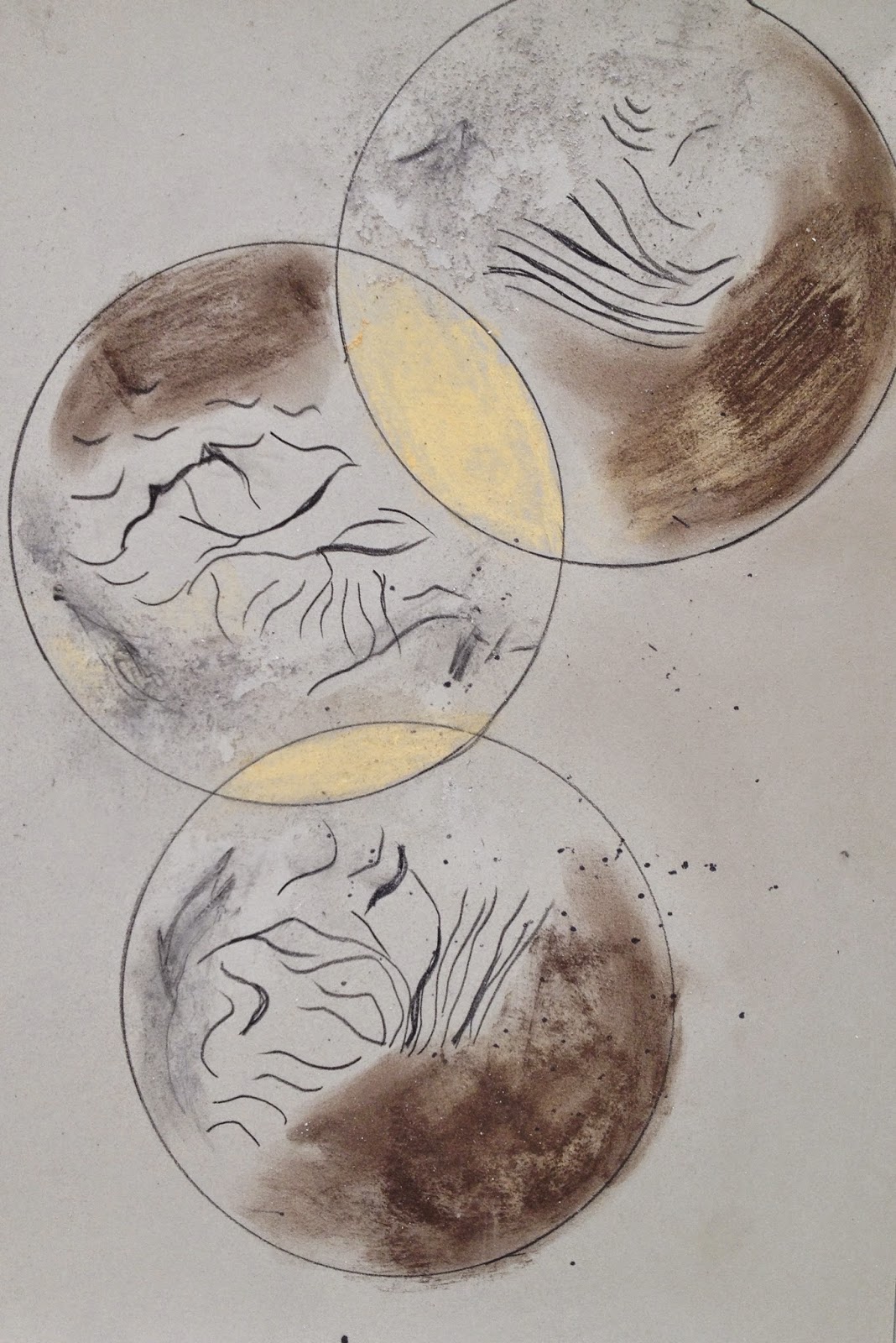
touching circles 

Contour drawing 

working into plaster on board 


tryptic of frotage ash and found material

lovely sketch book work 


profile by touch and contour drawing

inverted profile and contour drawing 

Touching forms 

detail of tryptic 


Sunday, 22 March 2015

How to write an artists statement


Colin Pink is an experienced play write and poet. He also works as a coach and curates. Colin’s  workshop ran for 3 hours and was an intensive experience looking at examples of statements good and bad. This helped us to think about what comes across in the subtext of our statements and in what context our statements are read and understood.
A detailed visualisation created a place from which to start writing along with some simple rules that improve form and style and we had to actually sit and write… After a bit of a panic I got down to it and incredibly made a huge cognitive shift in my own understanding of my practice. Up to now I had been drawing  in the landscape in black and white and had always stated that upfront, here I realised that my work is becoming more about depth, this enabled me to imply what my work was about without stating the obvious. This has given me and my statement much better impact and clarity.
It is still a work in progress but I feel now I can say confidently
‘My work is about depth. Creating pieces inspired by landscape I build up surface repeatedly covering and exposing ideas.
Patches flood with black pigment and charcoal lines over gesso ground, defining boundaries both real and metaphorical.
I feel connection during the making process, this energy underpins the strength and powerful nature of vulnerability. ‘
The workshop is being repeated in October at Jerwood Gallery Hastings. I really recommend the investment.

Monday, 16 March 2015

Water Line - Water week 2 Herstmonceux Castle

Waterweek2015 I contributed 4 boards, Boundary, Deposit, Seam 1 and 2 and an afternoon of experimental action drawing using moat water, accessible to anyone willing to jump on a scooter or a skateboard...

'Boundary' shown at Herstmonceux Castle 

Herstmonceux Castle

'Deposit' on the left at Gallery North Hailsham


'seam 1' shown in Herstmoncuex Castle


'Deposit' shown at Gallery North 
'Seam 2' shown at Herstmonceux Castle

raising moat water for Water line drawing


Friday, 27 February 2015

5 senses workshops SEE - the eyes are listening...


SEE

We use this sense probably the most and are rapidly becoming conditioned to see in particular ways through exposure to instant culture throughout the media. 

On a more mundane level we all need to see to live a daily life and just noticing details or looking at our surroundings in a different way can be inspiring. 

This week's workshop was about seeing through the eyes of an artist, how and what we see and how we translate that into marks. 

I visited The eyes are listening at Hastings Museum recently and loved the large paintings of Tom Hammick.


In terms of creating artwork I am very interested in the right brain left brain function. After reading Betty Davis' book, Drawing on the right side of the brain, I am sure there are ways of strengthening our use of the right brain thus being able to harness its global skills and lack of critical awareness  allowing creativity to grow. 

So to get students started and to switch off the left brain function we drew an upside down drawing, This is an exercise to copy a drawing by Picasso of Igor Stravinsky. By doing this the brain reads the lines and marks as just that, it no longer recognises them as eyes, arms, a collar etc so the right brain is in control and this allows the student to make a drawing without preconceived knowledge and spacial judgement . The result is a better drawing. Still not necessarily perfectly (if there is ever such a thing) accurate but conveying a more real sense of the original subject. 


Time changing greatly affects what we see so students drew from view finders on the windows to record what they could see at different intervals during the workshop - overlaying the images made on tracing paper. 


I had asked students to bring in white objects to draw so we could just focus on the forms without too much distraction while they made 3 specific drawings, 1st to make a drawing using usual observation, 2nd to make a drawing looking at the subjects and not the paper, trusting the eye and the hand to connect to create an image, 3rd to make a drawing entirely from memory of the subjects, by removing them. 


I hope doing these drawings in this way highlighted how we store up image in our brain, and when we draw we can either use the images accumulated subconsciously by just living or we can re learn new lines, angles and marks by looking carefully and memorising by repetition these new images. Increasing our own artists resource of our mind. 

Students then continued to draw the white still life using slit shaped view finders.